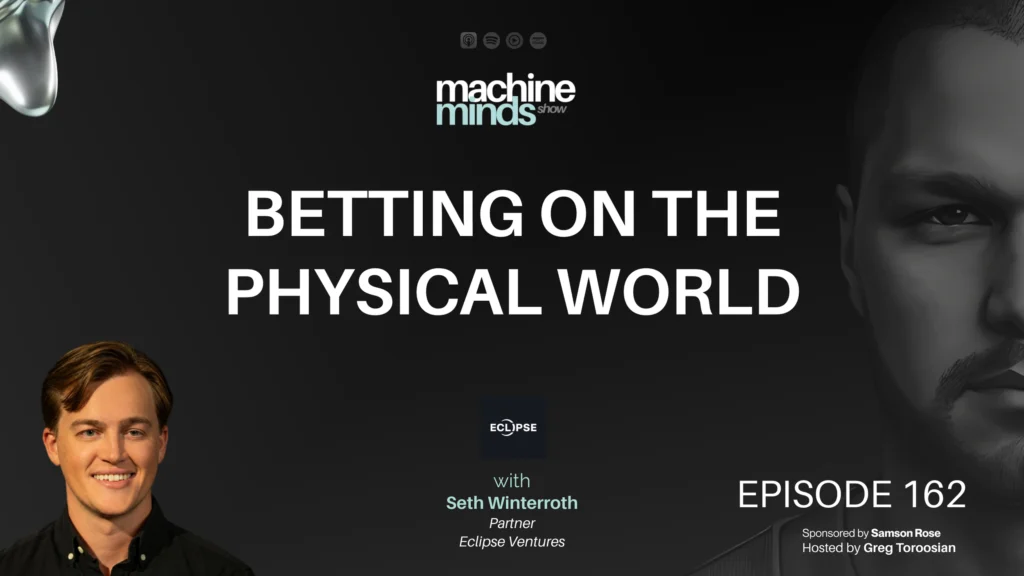

Robotics has never had more capital, talent, technology, or customer interest behind it. But for all the excitement around physical AI, Seth Winterroth believes the industry is entering a much harder phase: proving that the robots can actually work in the real world.
Seth Winterroth, Partner at Eclipse, returns to Machine Minds to unpack the shift from robotics hype to commercial execution. After more than a decade investing in the physical economy, Seth has lived through both the coldest periods of robotics investment and the current surge of capital flooding into the category. His message to founders is simple: the technology is ready, the market is ready, and now companies have to ship.
Greg and Seth explore why impressive demos and model breakthroughs are only the beginning, what separates teams that survive the difficult transition into production, and why the next generation of robotics winners will be defined by reliability, customer value, disciplined capital allocation, and strong unit economics.
Highlights:
- Why Seth believes robotics is still only in the early innings, despite the enormous growth in capital, talent, technology, policy support, and commercial interest around physical-world industries.
- How robotics went from an overlooked corner of venture investing to one of the most competitive and highly funded technology categories.
- The downside of a frothy market, including overcapitalization, lack of focus, inflated valuations, and companies that may ultimately have very little to show for the money they raised.
- Why founders need to shift their focus from compelling narratives and flashy demonstrations toward production systems that are reliable, safe, scalable, and economically valuable to customers.
- Seth’s challenge to the industry: “Where are all the robots?” and why companies that fail to get real systems into the world may not survive the next phase of the market.
- Why deep tech investing requires evaluating qualitative signals long before revenue appears, from how teams respond to difficult first deployments to whether founders can evolve into effective commercial leaders.
- Seth’s “go slow to go fast” philosophy and why understanding product specifications, customer requirements, integration constraints, and economics early can dramatically accelerate execution later.
- What the strongest robotics teams do after a painful first deployment, and why enthusiasm for building Gen 2 can reveal more about a company’s future than its current financial metrics.
- Why founders, not hired sales executives, often need to win the first major customers and create the initial commercial playbook themselves.
- How Eclipse thinks about capital allocation, including when startups should preserve their balance sheet and when a proven path to distribution creates an opportunity to become more aggressive.
- Why Bedrock Robotics’ driver-out autonomous excavators represent the kind of real-world proof Seth wants to see across the industry, and why deployment is only the beginning of the next challenge around utilization, scale, and ROI.
- The three factors Seth considers when evaluating a robotics opportunity: technical capability versus application complexity, a credible path toward attractive unit economics, and the amount of capital the company can realistically raise.
- Why building a technically impressive product is not enough if its cost structure will never support a sustainable business.
- Why Seth pushes back on the idea that robotics has already reached its “ChatGPT moment,” arguing that transformative moments happen when customers experience exceptional products, not when impressive capabilities remain inside a lab.
- The full-stack engineering work required to turn advances in AI models into real products, from sensors and compute choices to latency, memory constraints, reliability, and hardware integration.
- Seth’s view on overhyped and underrated areas of robotics, including world models, surgical robotics, autonomous driving, and data collection companies.
- The investing lesson he has learned from working with exceptional founders: give outlier people room to operate differently while still holding them to the ultimate standard of building a great business.
- Why Seth remains deeply optimistic about the future of robotics, hard tech, manufacturing, energy, transportation, and the broader physical economy.
For founders building robotics and hard tech companies, investors trying to understand where the category goes next, or anyone wondering when today’s physical AI breakthroughs will translate into products at meaningful scale, this conversation offers a grounded look at what happens after the hype.
Learn more about Eclipse: https://eclipse.vc/
Connect with Seth Winterroth: https://www.linkedin.com/in/sethwinterroth/
Connect with Greg Toroosian: https://www.linkedin.com/in/gregtoroosian/